Tuesday, January 10, 2017
New site for fact-checking global "disinformation"
Radio Free Europe has launched a site whose mission is to fact-check "global disinformation" news stories - primarily Russian. Go here to check it out!


Monday, January 2, 2017
"The Interpreter" - news and analysis from Russia and the near abroad
"The Interpreter" is a source for recent news from Russia and its near abroad, with translations of pertinent news items and documents - a very valuable tool.
Monday, December 5, 2016
The CIA has declassified its map archive!
The CIA's Cartography Center has released roughly 130 maps from its archive. Go here for a news piece and here for the collection, which includes some 200 images as well. It isn't clear from the release (on Flickr) just what the criteria were, but it's safe to say that hundreds remain hidden in CIA-only custody. (It's a little confusing, but this link also takes you to what appears to be the map and imagery collection.)


Thursday, October 27, 2016

Tuesday, September 27, 2016
38North blog: Everything you wanted to know about North Korea
North Korea is working on a new rocket engine, and one explanation from the DPRK government is that it may be utilized for eventual lunar exploration. But a more plausible reason for the engine's development is use in future ICBMs which could carry atomic payloads to targets in the US. The project may involve collaboration with Iran, according to the New York Times (see the link above) and the 38North blog, a site run by the US-Korea Institute at Johns Hopkins SAIS.
38North is a great site, and should be used by anyone with an interest in East Asian current events.
38North is a great site, and should be used by anyone with an interest in East Asian current events.
Tuesday, January 14, 2014
Yet more maps on visualizing how the world works
Today (January 14, 2014), the Washington Post published yet another article on some new and fascinating maps, showing us, among other things, how wealth is distributed worldwide, population dynamics, worldwide happiness, and where the ingredients for Nutella come from!

The article, entitled "40 More Maps That Explain the World," is the latest in an installment beginning with, appropriately, "40 Maps That Explain the World" published in August.
Check them out - lots of fun!

The article, entitled "40 More Maps That Explain the World," is the latest in an installment beginning with, appropriately, "40 Maps That Explain the World" published in August.
 |
| Europe in tweets |
 |
| The world's most and least emotional countries |
Check them out - lots of fun!
Sunday, November 3, 2013
Burmese child soldier twins reunited
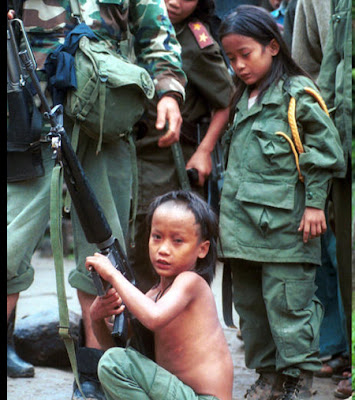
A fascinating story on the "God's Army" twins who fought a guerilla war in the jungles of Burma a decade ago. They were children then, and their adult followers attributed magical, super-human powers to the brothers. After a campaign of skirmishes, battles, and hostage-taking, God's Army was disbanded. The twins have been separated for years, one living in Sweden and the other in a refugee camp in Thailand. They were recently reunited and gave an interview to an AP reporter.
Monday, October 28, 2013
"The Dissident's Tookit"
Wow! If you want to read a fresh, empirically-based analysis of what make democratic revolutions succeed, take a look at this just-published piece by Erica Chenoweth in Foreign Policy. She stresses that there is no one strategy for success, and provides real insight into the process.
Here is one of many passages that stand out:
"The results of our research show that opposition campaigns are successful when they manage to do three key things: (1) attract widespread and diverse participation; (2) develop a strategy that allows them to maneuver around repression; and (3) provoke defections, loyalty shifts, or disobedience among regime elites and/or security forces."

Here is one of many passages that stand out:
"The results of our research show that opposition campaigns are successful when they manage to do three key things: (1) attract widespread and diverse participation; (2) develop a strategy that allows them to maneuver around repression; and (3) provoke defections, loyalty shifts, or disobedience among regime elites and/or security forces."

Friday, October 25, 2013
Outstanding piece on the South China Sea
Just extraordinary multi-media piece from the New York Times on the struggle for control of the South China Sea, with a fascinating look into how the Philippines government is coping. Go here...

Monday, September 9, 2013
"Putin's Kiss"
Haven't seen this film yet, but the acclaimed "Putin's Kiss" explores the true story of a Russian woman's embrace of the Nashi youth group and her ultimate realization that she had been manipulated and that Nashi was a malevolent force in Russian politics. The film can be downloaded here.

The Shia-Sunni split
From the Economist, a very brief but useful introduction on the Sunni-Shia schism amongst Muslims.
Wednesday, August 21, 2013
Confidential document surfaces on attitudes and angst inside the Chinese Communist Party
One of the most important articles in years on the attitudes of the highest echelons of the CCP is here in the New York Times. Author Chris Buckley details the contents of "Document No. 9," which blasts “Western constitutional democracy” as well as “universal values” of human rights, Western-inspired notions of "media independence and civic participation," and other insidious ideas creeping into Chinese political discourse.
Wednesday, August 7, 2013
Japan launches something that looks a lot like an aircraft carrier
Honestly, it isn't an aircraft carrier, and the Japanese say it's a "flat-topped destroyer." It can't launch fixed-wing aircraft, although it will carry fourteen helicopters.
Might come in handy for protecting Japan's assets in the South China Sea...

Might come in handy for protecting Japan's assets in the South China Sea...

Monday, July 8, 2013
The Egyptian Economy's Nosedive Since the Revolution
Informative, fascinating piece by Matt Phillips at Quartz on the Egyptian economic mess since Mubarak was overthrown.
Monday, June 17, 2013
Recent information on coltan

Go here for their page on "The Illicit Trade of Coltan."
Wednesday, June 5, 2013
More on China's (bogus) claims to the South China Sea
Excellent article this week by Mohan Malik at World Affairs on the totally specious claims by China to a huge area in the South China Sea. A must-read if you're interested in the topic.
Sunday, January 27, 2013
Central Asia's water issues - excellent article!
In a piece from Radio Free Europe, Professor Brahama Cellaney discusses water, the emerging nexus of conflict in Central Asia. Lots of great quotes, but I like this one since it sums up the dilemma faced by weak states such as Kyrgyzstan:
And I think given the fact that Uzbekistan is located downstream, but able to assert its political and military supremacy in the region, Tajikistan and Kyrgyzstan find themselves hamstrung. They're not able to embark on projects because the downstream power is unwilling to provide consent, and they're too afraid to embark on projects on their own.
And I think given the fact that Uzbekistan is located downstream, but able to assert its political and military supremacy in the region, Tajikistan and Kyrgyzstan find themselves hamstrung. They're not able to embark on projects because the downstream power is unwilling to provide consent, and they're too afraid to embark on projects on their own.
Monday, January 21, 2013
Thomas Friedman: "Oh, you were taking me literally?"
Thomas Friedman wrote a rather self-serving piece today at Foreign Policy on the flaws in his "petropolitics" thesis. He kinda, sorta acknowledges the lack of empirical support for his argument, but then says of his chief critic, "I would simply note that [he] focuses on the effects of oil prices, which is a literal reading of the "first law.""
Oh. A "literal" reading. Should we have assumed you were being figurative when you stated that your "law" was a causal relationship between oil prices and authoritarianism?
Remember, we said that Friedman's article was an interesting thought piece but shouldn't be taken too seriously. Nice to know that he kinda, sorta agrees.
Oh. A "literal" reading. Should we have assumed you were being figurative when you stated that your "law" was a causal relationship between oil prices and authoritarianism?
Remember, we said that Friedman's article was an interesting thought piece but shouldn't be taken too seriously. Nice to know that he kinda, sorta agrees.
Saturday, January 5, 2013
2012: The Year in Unfreedom

As Foreign Policy author Christian Cayle reminds us in this trenchant post-mortem on the world's fledgling democratic states, "Voting does not a democracy make."
Monday, December 24, 2012
Why so many dynasties?
You might want to take a look at this piece in Foreign Policy on the persistence of dynastic regimes in the modern world. The author focuses on Asia, where dynasties thrive in the Koreas, Thailand, Bangladesh, and elsewhere.
Subscribe to:
Posts (Atom)